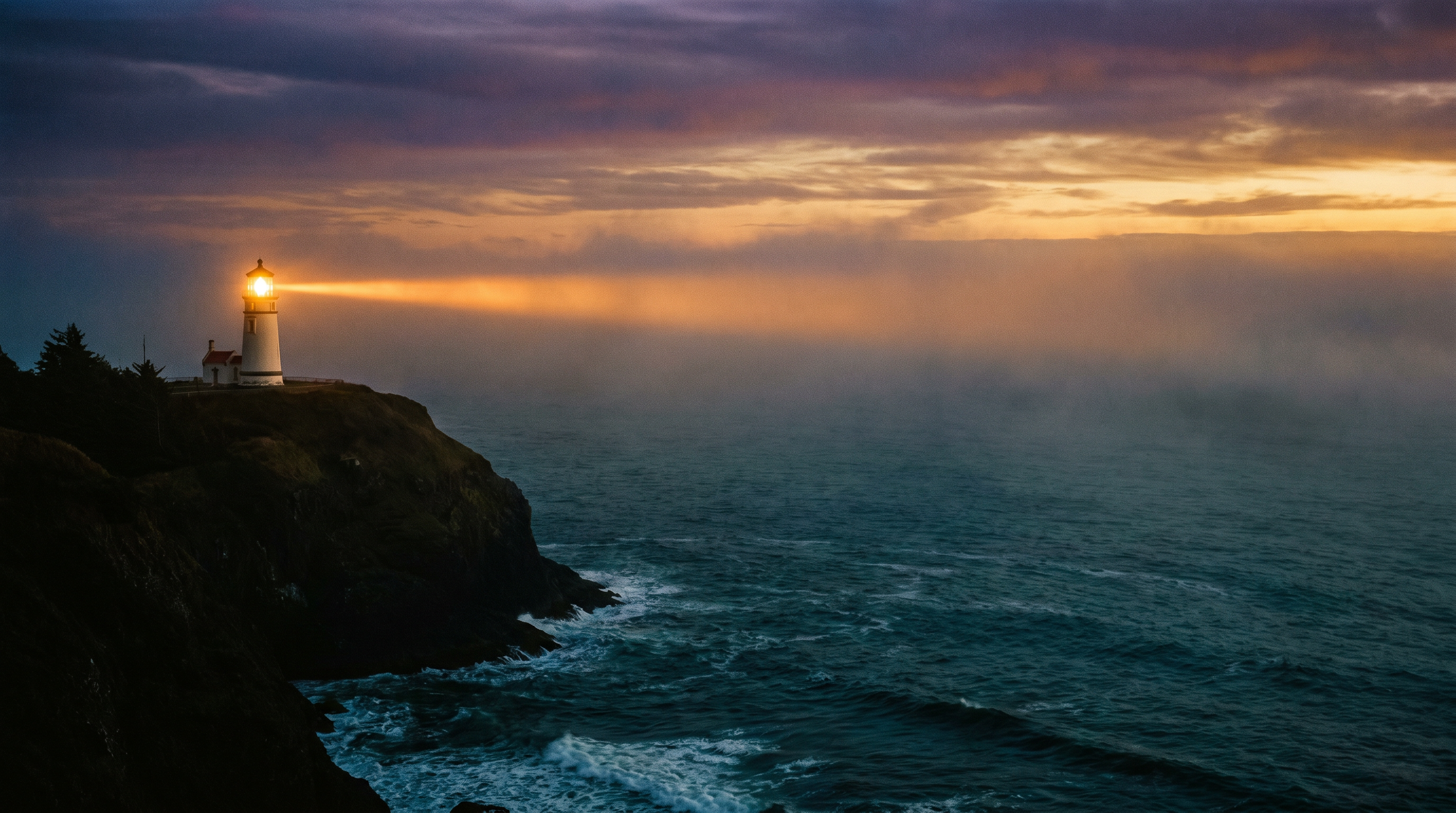
Ninety miles of dark water
Before 1894, there was a ninety-mile gap on the Oregon coast.1 Between the lights at Yaquina Head to the north and Cape Arago to the south, ships moved in the dark. Not metaphorically. Literally. For ninety miles there was nothing to fix your position against.
The U.S. Lighthouse Board had known about the gap since 1888.2 Congress appropriated $80,000 in 1889.1 A wagon road had to be cut seven miles through basalt and beach dune before a single stone was laid. The lens — 640 hand-ground prisms, manufactured by the Chance Brothers of Birmingham, England — arrived by ship in October 1893.2
The light was first lit on March 30, 1894.1 The keeper was Andrew Hald, who had walked twenty-four miles down the beach to reach the station.2 He struck a wick no bigger than a candle. The lens did the rest.
What concentration actually means
A conventional lens is a slab of glass. It bends light, yes — but it also absorbs it. The thicker the glass, the more light is lost before a single ray reaches the sea. When Augustin Fresnel went before the French Commission des Phares in 1819, his question was not "how do we make the lamp brighter?"4 His question was: how do we stop wasting what we already have?
His answer: strip out all the glass that doesn't bend light and keep only the bending surfaces. Concentric rings of precisely angled prisms — a beehive of glass — each ring catching light at a different angle and redirecting it toward the horizon, not up, not down, not sideways. The catadioptric outer prisms go further still, using total internal reflection to turn even light from behind the lamp into forward beam.4
The lens does not add energy. It stops throwing energy away. That is the entire invention. A refusal to waste.
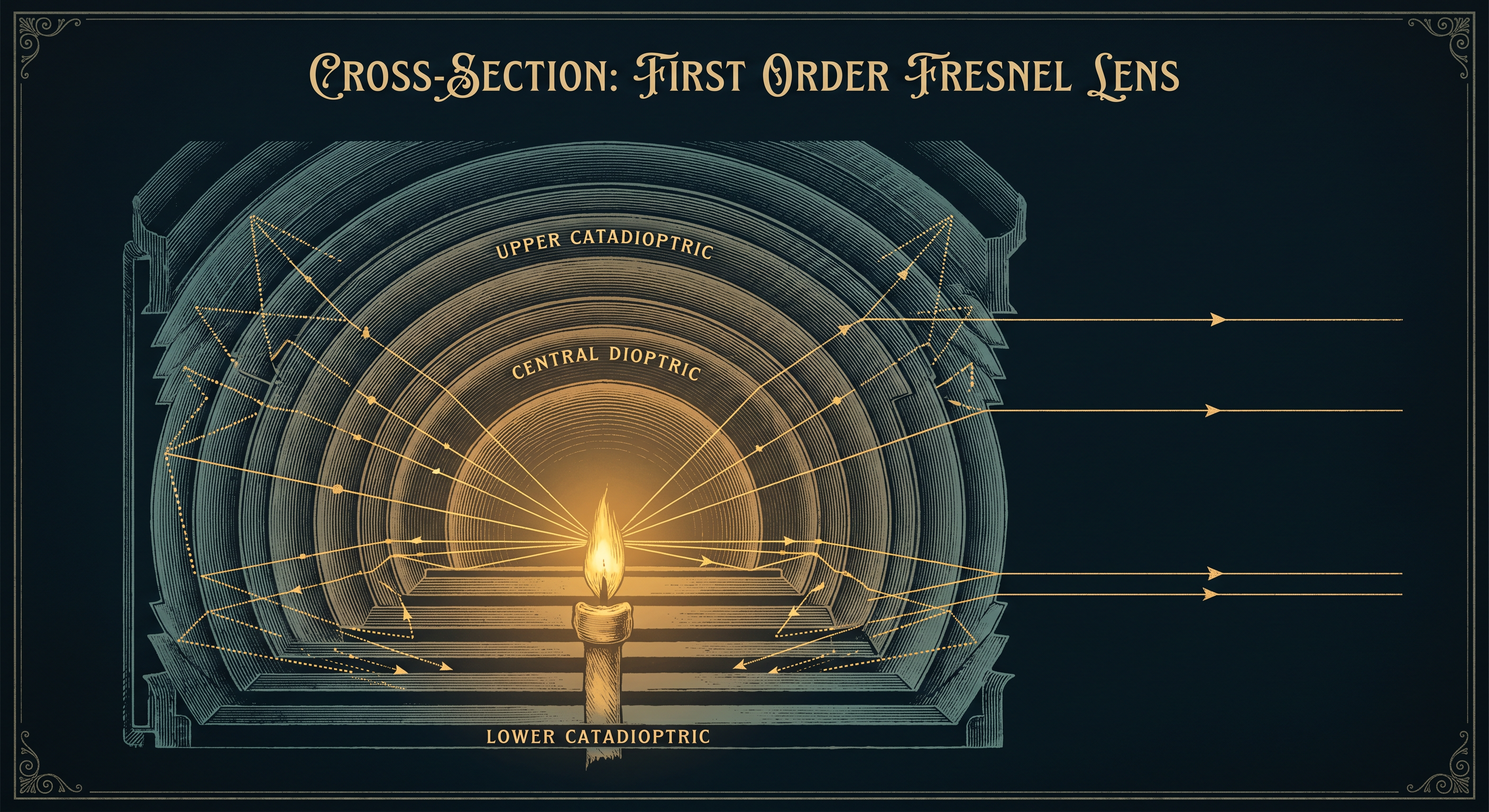
The prisms do not generate light. They assign it a direction. Before Fresnel, most of what a lighthouse produced simply went to the ceiling.Anchors & Algorithms — on the physics of the Fresnel lens
Your dataset is the same problem
In machine learning, the working definition is clean: data = signal + noise.5 The signal is the repeatable pattern, the thing a model should generalize from. The noise is everything else — sensor drift, labeling errors, the thousand forces you didn't measure and won't.
The naive answer is to add more data. The Fresnel answer is different: figure out where you are wasting what you already have, and stop. A harbor pilot understands this. It's what separates her from a tourist standing on the same dock, watching the same water. Same ocean. Different signal extraction.
By the late 19th century, common lighthouse reflectors were bouncing only about half the incident light back into service.4 A well-designed Fresnel lens can capture upward of 97% of emitted light and send it toward the horizon.6 Attention mechanisms in modern neural networks do something structurally similar: instead of treating every token in a sequence with equal weight, they assign importance scores — amplifying what matters, suppressing what doesn't.7
Signal-to-noise ratio — a working definition
"The ocean is full of noise — waves, wind, light bouncing off chop. The lookout's job was to find the one thing that didn't belong."
Fresnel's central insight — that the geometry of collection matters more than the strength of the source — appears again in dimensionality reduction, in attention, in regularization. Principal component analysis projects data onto the directions of highest variance and discards the rest, exactly as a lighthouse prism throws light toward the horizon and nowhere else.5
The 19th-century opticians didn't have backpropagation. They had geometry, patience, and the conviction that scatter is the enemy. They were solving, in the most precise sense, the same problem.
The keeper climbs at dusk
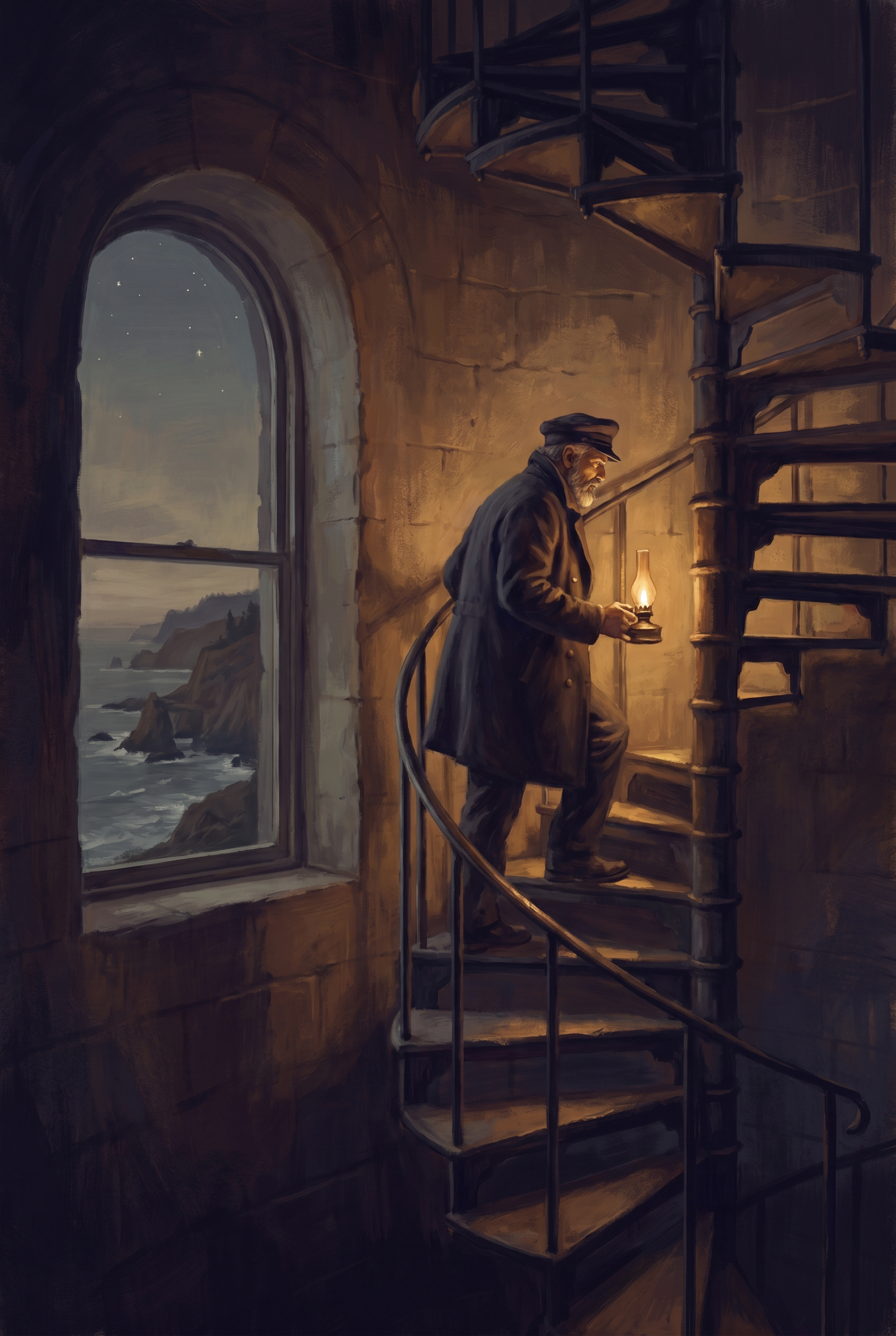
Andrew Hald spent five years at Heceta Head.2 The station was remote enough to have its own post office and a one-room schoolhouse. His wife suffered a serious illness there. His infant daughter died — the road too long, help too far.
Still, every evening, he climbed. He lit the wick. The lens turned — at first by a clockwork weight mechanism, the whole apparatus rotating on a film of mercury — and eight beams swept the Pacific in sequence, each bull's-eye panel producing a flash as it passed your bearing.2
In 1934, electricity arrived. A 500-watt bulb replaced the oil lamp, increasing light output more than fivefold.2 The lens now runs on a 1,000-watt bulb producing 2.5 million candlepower8 — still wearing its original Birmingham glass. The only recorded failure: February 12, 1961, when a rockslide severed the electric line and Keeper Oswald Allik and two assistants turned the lens by hand through the night, walking circles inside the lantern room until morning.2
By the time the wave reaches the shore, the storm that made it is already gone. A slow dashboard is the same problem. The light that arrives twenty-one miles out is not delayed. It left the moment the wick caught.Information latency, as understood from a headland 205 feet above the Pacific
Doing more by throwing less away
Heceta Head Lighthouse is the most photographed lighthouse in the United States,9 which is its own kind of irony. The thing everyone comes to photograph is not the structure. It is the beam. The act of concentration, repeated every eight seconds, still wearing the same Birmingham glass it wore in 1894.
The lens has never been replaced.2 Oregon Parks and Recreation manages it now as a private aid to navigation — the Coast Guard transferred the property in 2001 after a full restoration of the pedestal and drive mechanism.1 What Chance Brothers ground by hand in Birmingham still holds the geometry Fresnel derived in 1819.
The next time your model overfits, or your features drown in correlation noise, or your dashboard lags three seconds behind the event it was supposed to track — consider the prism. Not as metaphor. As engineering philosophy. The problem was always scatter. The answer was always geometry.
Situational awareness — a working definition
"It's what a harbor pilot has that a tourist doesn't. Same water. Different eyes."
References
- Marsh V. Heceta Head Lighthouse. Oregon Encyclopedia. Oregon Historical Society; updated 2024 Aug 12 [cited 2026 Jun 5]. Available from: oregonencyclopedia.org/articles/heceta-head-lighthouse/ ↩
- Anderson K. Heceta Head Lighthouse, Oregon. Lighthousefriends.com. [cited 2026 Jun 5]. Available from: lighthousefriends.com/light.asp?ID=131 ↩
- Oregon State Parks and Recreation Department. Heceta Head Lighthouse State Scenic Viewpoint [cited 2026 Jun 5]. Available from: stateparks.oregon.gov/…/parkId=86 ↩
- Fresnel lens. Wikipedia, The Free Encyclopedia. [updated 2025; cited 2026 Jun 5]. Available from: en.wikipedia.org/wiki/Fresnel_lens ↩
- Iguazio. What is noise in ML. Iguazio Glossary [cited 2026 Jun 5]. Available from: iguazio.com/glossary/noise-in-ml/ ↩
- Kewaunee Pierhead Lighthouse. The Fresnel Lens [cited 2026 Jun 5]. Available from: kewauneepierheadlighthouse.org/the-fresnel-lens ↩
- Ultralytics. Attention Mechanism. AI Glossary [cited 2026 Jun 5]. Available from: ultralytics.com/glossary/attention-mechanism ↩
- ExploRVistas. Heceta Head Lighthouse. 2017 Jun 9 [cited 2026 Jun 5]. Available from: explorvistas.com/2017/06/09/heceta-head-lighthouse/ ↩
- Harlow T. History and Highlights of Heceta Head Lighthouse. 2025 May 22 [cited 2026 Jun 5]. Available from: timothyharlow.com/…/heceta-head-lighthouse/ ↩
Citation Appendix
Sources Consulted
| URL | Accessed | Tier |
|---|---|---|
| oregonencyclopedia.org/…/heceta-head-lighthouse | 2026-06-05 | Secondary |
| lighthousefriends.com/light.asp?ID=131 | 2026-06-05 | Primary (archival) |
| stateparks.oregon.gov/…parkId=86 | 2026-06-05 | Primary (state agency) |
| en.wikipedia.org/wiki/Fresnel_lens | 2026-06-05 | Secondary |
| en.wikipedia.org/wiki/Heceta_Head_Light | 2026-06-05 | Secondary |
| kewauneepierheadlighthouse.org/the-fresnel-lens | 2026-06-05 | Secondary |
| nps.gov/chis/…/fresnellens.htm | 2026-06-05 | Primary (NPS) |
| iguazio.com/glossary/noise-in-ml/ | 2026-06-05 | Secondary |
| ultralytics.com/glossary/attention-mechanism | 2026-06-05 | Secondary |
| explorvistas.com/…/heceta-head-lighthouse | 2026-06-05 | Secondary |
| timothyharlow.com/…/heceta-head-lighthouse | 2026-06-05 | Secondary |
| uslhs.org/node/1427 | 2026-06-05 | Secondary |
| hyperphysics.phy-astr.gsu.edu/…/fresnellens | 2026-06-05 | Secondary |
Sources Cited (inline)
| Ref. | URL | Published / Updated |
|---|---|---|
| 1 | oregonencyclopedia.org/… | 2024-08-12 |
| 2 | lighthousefriends.com/… | Archival — no pub. date |
| 3 | stateparks.oregon.gov/… | 2026-04-13 |
| 4 | en.wikipedia.org/wiki/Fresnel_lens | Active, 2025 |
| 5 | iguazio.com/glossary/noise-in-ml/ | 2026-04-19 |
| 6 | kewauneepierheadlighthouse.org/… | 2025-04-15 |
| 7 | ultralytics.com/glossary/attention-mechanism | 2026-01-28 |
| 8 | explorvistas.com/…/heceta-head-lighthouse | 2017-06-09 |
| 9 | timothyharlow.com/…/heceta-head-lighthouse | 2025-05-22 |
Recency Flags
| Data Point | Date Used | Note |
|---|---|---|
| 2.5M candlepower figure | 2017 | 2026 unavailable — From ExploRVistas 2017; lamp specification is a fixed hardware fact unlikely to have changed after the final 1000W bulb installation. |
| Lighthousefriends archival record | Undated | No pub. date — Long-standing archival site; all specific claims cross-verified against Oregon Encyclopedia (2024) and Oregon State Parks (2026). |