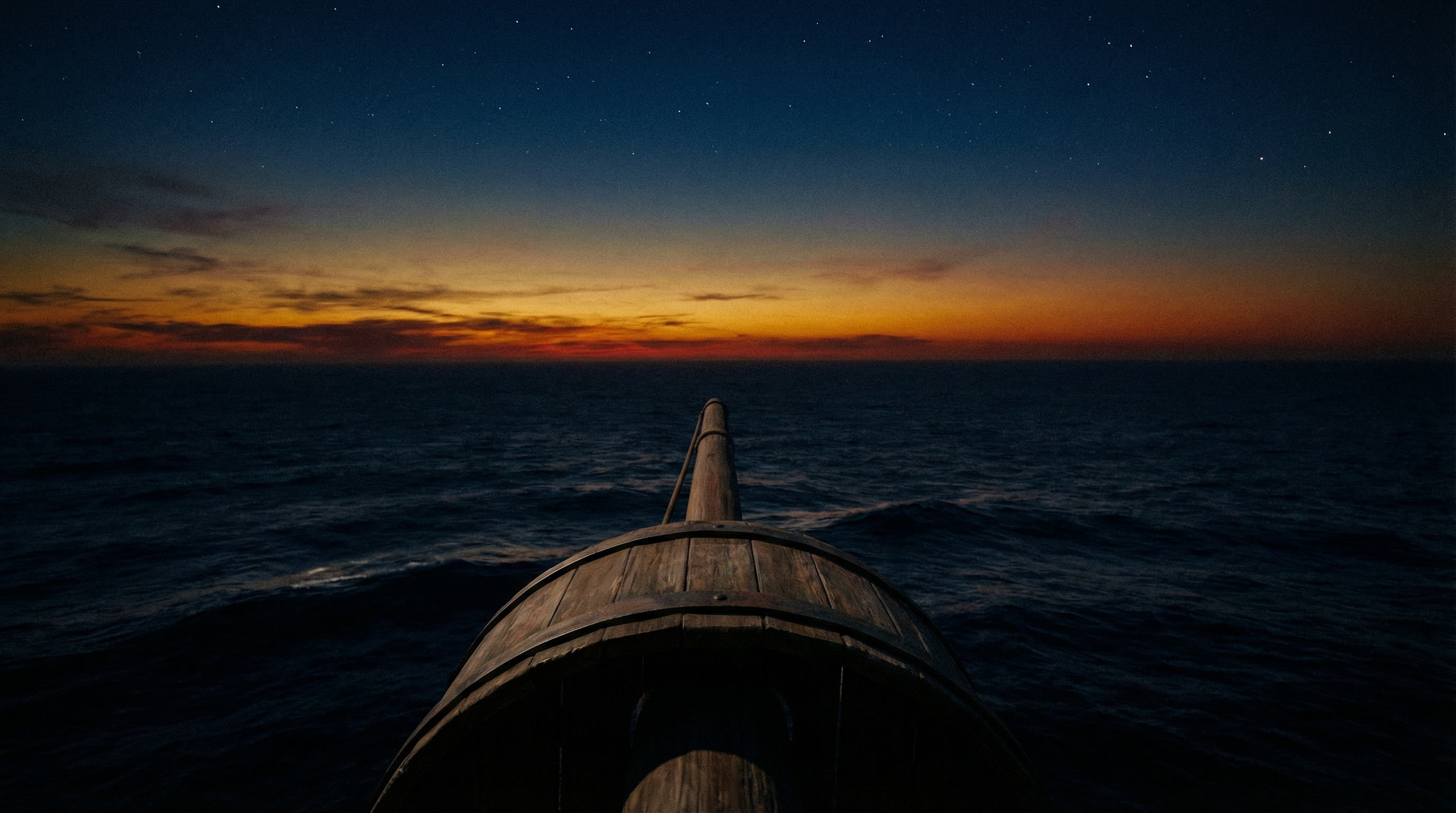
What do you see from up there?
Every captain has asked it. Every executive has lived it. You are below, in the noise and motion of the ship. Someone else is above, with the widest view available. Their job is simple: compress the world into what matters right now.
That is not a maritime function. That is a human need. We have been building tools to do it since before we had words for what we were doing. The crow's nest and the dashboard are the same invention, born in different centuries, solving the same problem.
This is the story of that problem — and the remarkable consistency of how we have answered it.
A barrel. A mast. A man with clear eyes.
In 1807, a Whitby whaling captain named William Scoresby the Elder1 lashed a wooden barrel to the top of his mast and climbed inside. The problem he was solving was ancient: the higher you stand, the further you see. The solution he built was elegant and ruthlessly simple.
His son, William Scoresby Junior, described it in his 1823 account of Arctic voyaging1 as "a circular box, like a small pulpit, fixed at the mast-head, for the accommodation of the captain or officer, who ascends through a little trap-hatch in the bottom." Wood. Canvas. A door in the floor. That's it.
But notice what that design already knows about information. The walls block wind, reducing sensory noise. The height maximizes field of view. The single lookout eliminates committee confusion. There is one signal source. One reporting line. The captain below asks: what do you see? The lookout above answers. That is a dashboard.
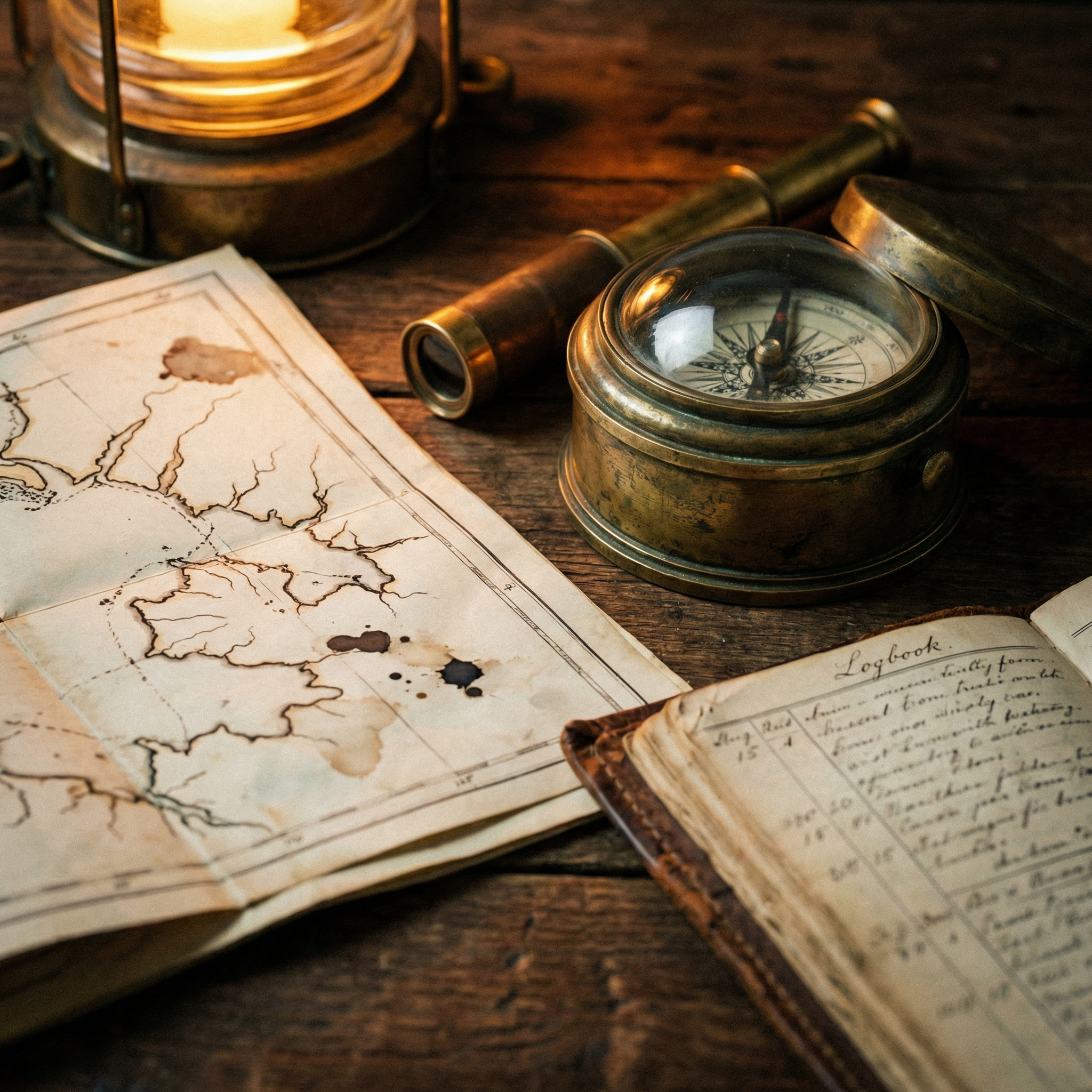
The instruments of perception. Brass, glass, and ink — every tool designed to extend one human's awareness beyond what their body alone could reach.
Herman Melville, Moby-Dick, Chapter 35: The Mast-Head, 18513
Frederick Fleet. April 14, 1912. 11:39 in the evening.
He was 24 years old.4 He had been in the crow's nest of the RMS Titanic for two hours. The night was clear and very cold. The ocean was calm — dangerously calm, as it turned out, because there were no waves breaking at the base of what lay ahead.
He saw something. He rang the bell three times — the standard signal for an obstruction ahead — and telephoned the bridge: "Iceberg, right ahead."4 The ship turned. Not fast enough.
Days later, at the United States Senate inquiry, Senator Smith asked Fleet whether binoculars would have helped. There were none in the crow's nest that night — they had been locked away, and the key left behind in Southampton.5
Fleet's answer should be printed above every executive dashboard in every company on earth.
"We could have seen it a bit sooner."
Not: "The iceberg was invisible." Not: "Nothing could have been done." Just: a bit sooner. That is the entire argument for better dashboards, compressed into four words. Earlier signal. More time. Different outcome.

Every great tool carries the memory of what it replaced.
The word "dashboard" first appeared in 1846.6 It named the board at the front of a horse-drawn carriage that stopped mud from being dashed upward at the driver. A literal mud-guard. A piece of wood between the driver and the chaos of the road.
By 1904, the same word had migrated to the automobile — now naming the panel of gauges that told drivers what the engine was doing without requiring them to open the hood.7 Same idea. Different century. The driver still needed to watch the road, not manage the machinery.
The metaphor kept climbing. In 1978, engineers at Lockheed-Georgia built the first electronic executive information system.8 In 1982, John Rockart and Michael Treacy of Harvard Business School published "The CEO Goes On-Line" in the Harvard Business Review,8 giving the idea academic weight and a new audience: the corner office. In 1989, Howard Dresner of Gartner coined the phrase "Business Intelligence."8
The word evolved. The function never changed. Keep the driver's eyes on the road. Not on the mud.
William Scoresby Sr. invents the barrel crow's nest for Arctic whale-fishing. Height as information strategy.2
First recorded use of "dashboard" — a mud-deflecting board on a horse carriage. Noise reduction as design principle.6
The automobile instrument panel inherits the name. Engine data surfaces to the driver without interrupting their attention.7
First electronic executive information system built at Lockheed-Georgia. The same logic, now digital.8
Howard Dresner of Gartner coins "Business Intelligence." The crow's nest gets a brand name.8
Knowing what is happening is not the same as knowing what to do.
In 1995, cognitive engineer Mica Endsley published a landmark paper in Human Factors journal10 that finally gave a scientific name to what every lookout and every navigator has always practiced. She called it Situational Awareness, and she broke it into three levels.
Think of them as three questions the crow's nest is always trying to answer.
Perception
Seeing the signal in the first place. Most errors happen here — not from bad decisions, but from information that never arrived.
The lookout spots the smudge on the horizon. The chart shows the depth change. The gauge shows the pressure drop.
Comprehension
Understanding what the signal means. Seeing a shape is not enough. Is it a ship? A whale? A rock? Context turns data into knowledge.
The smudge is white. It is not moving. It is large. It is an iceberg. The pressure drop means a storm is coming.
Projection
Knowing what will happen next if the current course holds. This is what transforms awareness into action before the moment of impact.
At this speed, on this heading, we will meet that iceberg in four minutes. Ring the bell. Call the bridge. Now.
It is a harbor pilot's advantage over a tourist. Same water. Different eyes — because one of them has built a mental model of the entire harbor, and the other is just looking at waves. Every good dashboard is an attempt to give more people the harbor pilot's eyes.
Mica Endsley — Toward a Theory of Situation Awareness in Dynamic Systems, 199510
It does not tell ships where to go. It tells them where the rocks are.
Forty miles up the coast from where this page was written, Yaquina Head Lighthouse stands on a dark basalt promontory above Newport, Oregon. The tower is 93 feet tall.9 It sits on a cliff 162 feet above the Pacific.9 Its light was first lit on August 20, 1873, by keeper Fayette Crosby.11 On a clear night, a ship can see it 19 miles out to sea.9
Think about that geometry. The lighthouse stands still. Ships move. The light says: here is a fixed point of known danger. Navigate accordingly. It is the oldest kind of data visualization — a single, unambiguous signal, visible from 19 miles away, that encodes everything you need to know about this particular stretch of coast.
The lighthouse does not manage ships. It does not tell them their speed, or their fuel state, or their cargo manifest. It tells them exactly one thing, at exactly the moment they need to know it, with enough lead time to act. That is a model worth meditating on.
Today's data dashboards are sometimes accused of telling you too much. The lighthouse has no such problem. It has been trusted with a single truth, and it tells that truth, every night, without fail, across 19 miles of dark water. What is the one thing your dashboard should be saying?
The same invention, born twice.
William Scoresby climbed into his barrel in 1807 because the ocean was too large for unaided eyes. Hans Lippershey ground his lenses in 160813 because the sky was too vast for naked vision. The first keeper lit Yaquina Head in 1873 because the coast was too dangerous for hope alone. John Rockart wrote his paper in 1979 because the corporation had grown too complex for intuition.
Every one of these people was solving the same problem. The world generates more signal than any one person can hold in their head. Something has to filter it. Something has to climb higher. Something has to say: here is what matters right now.
The best technology has never replaced that human need. It has only ever given it a better barrel to stand in, a taller tower, a cleaner lens, a brighter beam. The eye behind it is still yours. The judgment is still yours. The call to the bridge is still yours.
Frederick Fleet saw the iceberg. He rang the bell. He made the call. The instrument gave him the height; the perception was human. That partnership — tool and person, elevation and judgment — is as old as the sea.
And as necessary as ever.